
Deprecated: version_compare(): Passing null to parameter #1 ($version1) of type string is deprecated in /dom146695/wp-content/plugins/gravityforms/includes/addon/class-gf-addon.php on line 5706

Deprecated: Return type of GF_Field::offsetExists($offset) should either be compatible with ArrayAccess::offsetExists(mixed $offset): bool, or the #[\ReturnTypeWillChange] attribute should be used to temporarily suppress the notice in /dom146695/wp-content/plugins/gravityforms/includes/fields/class-gf-field.php on line 84

Deprecated: Return type of GF_Field::offsetGet($offset) should either be compatible with ArrayAccess::offsetGet(mixed $offset): mixed, or the #[\ReturnTypeWillChange] attribute should be used to temporarily suppress the notice in /dom146695/wp-content/plugins/gravityforms/includes/fields/class-gf-field.php on line 90

Deprecated: Return type of GF_Field::offsetSet($offset, $data) should either be compatible with ArrayAccess::offsetSet(mixed $offset, mixed $value): void, or the #[\ReturnTypeWillChange] attribute should be used to temporarily suppress the notice in /dom146695/wp-content/plugins/gravityforms/includes/fields/class-gf-field.php on line 99

Deprecated: Return type of GF_Field::offsetUnset($offset) should either be compatible with ArrayAccess::offsetUnset(mixed $offset): void, or the #[\ReturnTypeWillChange] attribute should be used to temporarily suppress the notice in /dom146695/wp-content/plugins/gravityforms/includes/fields/class-gf-field.php on line 108
content writing – Maria Polansky

Tag: content writing

  • Is blogging still worth it for fashion & lifestyle brands?

    Is blogging still worth it for fashion & lifestyle brands?

    With AI overviews changing the search engine landscape, you’re probably wondering if blogging is even worth it anymore.

    They’re the first thing you see when you open up Google, and I can’t lie … they usually give pretty decent summaries about the question or topic given.

    But that doesn’t mean that blogging is dead. It just means that it’s changing. Read on to find out exactly what I mean and learn the answer to the million dollar question — if blogging is still worth it for fashion and lifestyle brands.

    Do you need a blog for your fashion or lifestyle brand’s website?

    No. It’s not as much of a need as say, a home page or product pages. There are plenty of fashion and lifestyle brands that are doing great without having a blog on their website.

    However, having a blog can still be very beneficial for fashion and lifestyle brands, even in this day and age. Here are a few reasons why:

    Enhances SEO + organic traffic

    Yes, even with the rise and prevalence of AI overviews, blogging is still a great way to boost your website’s SEO and bring in more organic traffic that hopefully includes new ride-or-die fans of your brand. What a lot of people don’t realize is that AI isn’t making up overviews from scratch — it’s pulling information from well-ranking articles and websites.
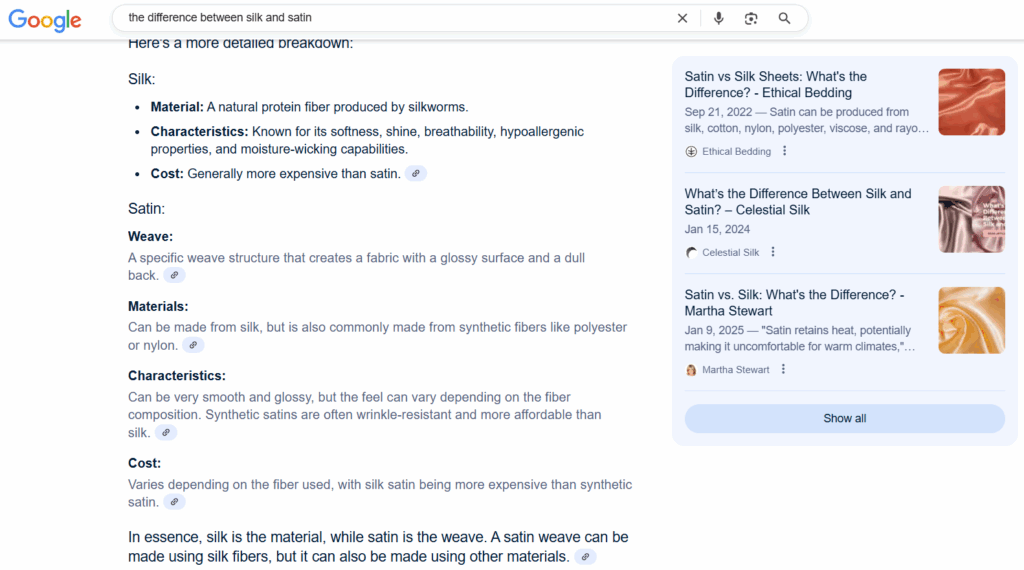
    Take a good, long look at this screenshot I took from my quick search about the difference between silk and satin.

    Sure, the first thing that came up was an AI overview. But observe the little symbols that appear next to every point. They’re links to the blog articles and web pages that the AI got its information from. And on the far right side of the screen? You can see three articles that were used to create the overview, and all of them come from the blogs and websites of lifestyle brands.

    So it’s not that AI overviews are making blogging redundant. AI overviews rely on blog articles to create these overviews. If your article ranks well, it’ll be right up there in the overview. Plus, some of the old principles of SEO still apply. If you scroll past the AI overview, you’ll still see the first page of the search engine and the highest ranking articles.
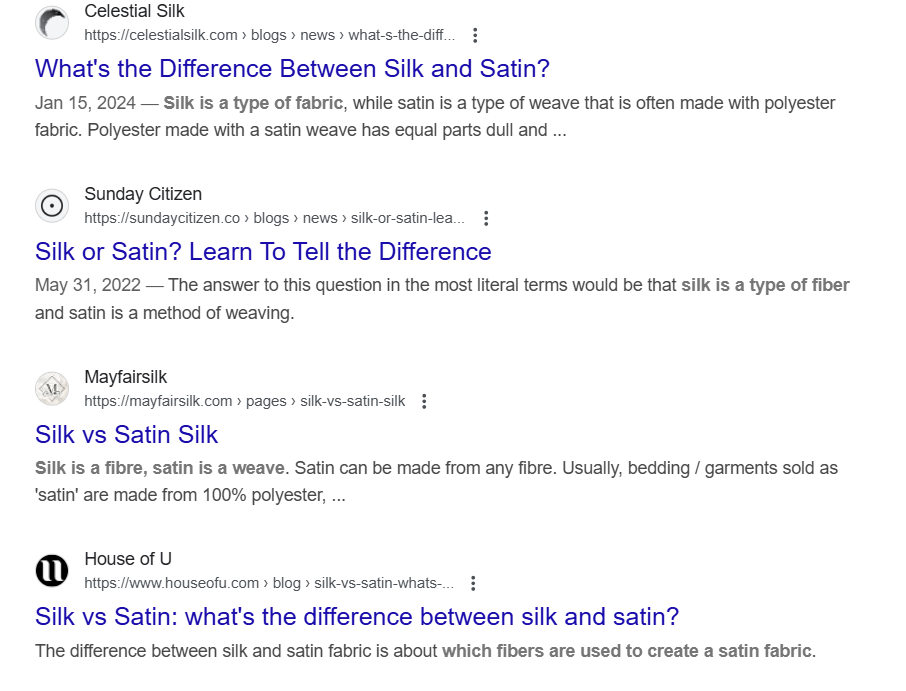
    With the exception of one, all of these top-ranking articles come from company blogs! Very telling stuff, isn’t it?

    Improves visibility

    Ever heard the saying “don’t put all your eggs in one basket”? Of course you have. Blogging is just another way to increase visibility and build brand awareness.

    The issue with social media is that your profile is never truly yours. Yes, you created all that content — but it technically belongs to the platform. If Instagram goes down or bans your page for some reason, then poof. All your hard work is gone. Emails are also great, but they can be deleted at any time.

    Having a solid website is so important, and blogging is just another way to make it richer and deeper.

    Creates a greater connection with your customers

    Social media and email marketing are great and have their own unique set of benefits, but they can be limiting in terms of space. Even the longest-form captions and emails don’t let you dive quite as deep into a topic as a blog post does.

    There’s also the headspace aspect. When people are on social media or checking their emails, they’re often in fast consumption mode. They probably want to quickly read and scroll onto the next thing, which is why short-form content reigns supreme on these platforms.

    But when you open a blog post? You’re more committed to reading, learning, and engaging. You’ve got yourself settled on the couch with a nice hot beverage at your side, and you’re ready to dive in. Ok, maybe that’s not always the case, but you’ve got to admit your headspace is different when you’re truly in reading mode.

    Blogs give you all the space you need to fully share your knowledge and educate your reader on the topic, therefore creating a deeper level of connection. Who knows, you just might end up writing the blog article that changes their perspective on an important topic — like learning the difference between silk and satin once and for all.

    Positions you as an expert in your industry

    A blog page filled with amazing resources for your audience is going to make you look good. I mean, why wouldn’t it?

    Let’s say you have a solid skincare brand, and a blog filled with articles and resources about sustainability, zero-waste living, and skincare tips. Your brand is going to look more legit than the competitor brand that doesn’t have any of that.

    Having a blog provides a lot of value to your audience, and it proves that you know your stuff. It’s like having a meal at a five star restaurant, where the server takes the time to explain the dish and the ingredients. You could have a delicious meal by itself, but the extra knowledge really proves the chef’s expertise.

    Streamlines content creation as a whole

    This might sound counterintuitive. After all, blogging is yet another form of marketing you’re adding to your already-full plate.

    But what if I told you blogging makes one of the best foundations for a general content strategy?

    Since blogs cover so many different aspects of a topic, you can use a single blog to create multiple emails and social media posts. It actually makes content creation easier, because you’re not reinventing the wheel every single time. Trust me, it really works. It’s a strategy I love using with my retainer clients.

    How to adapt your blogging strategy in the AI overview age

    Ok, so we know that while the internet has changed, some things remain the same. Blogging is still a great way to boost SEO and organic traffic, improve your brand’s overall visibility, build deeper connections with your audience, and position your brand as an authority/expert in your industry.

    But it’s a fact that AI overviews have changed the game. You can still get your blogs to rank, you just need to adapt them so they’re more appealing to the bots.

    While having high quality content is important, you might need to change the structure of your posts. Here are a few tweaks you can apply to your blog posts to make them more AI overview-friendly:

    Use your titles and headers strategically

    This has always been important, but now it’s extra important. You’ll want your titles and headers to really align with keywords and search terms, so save the prettier language for other forms of marketing and keep it very, very simple.

    Think about the words and phrases that your ideal customer would use. And if you’re not sure what that might look like, think about the words and phrases that you might use when you’re looking for something specific.

    For example: is it safe to wear gold jewelry in the pool?

    It doesn’t sound as nice as a title like “poolside jewels: gold pieces for your hot girl summer”, but it’s what people are actually searching for. You can use the fun titles for your email marketing and social media campaigns. Blogging these days is really about strategy.

    Make sure your content is clear, concise & conversational

    AI overviews are clear, concise, and (for the most part) conversational, which means your blog content should also be clear, concise, and conversational.

    It pulls phrases directly from blog posts, so you’ll want to write your sentences in a way that makes sense for an overview.

    And that’s where the conversational aspect comes in. You can and should stick to your brand voice, which might lean more elegant or playful, but try to write sentences that a person would actually say (or search) in real life.

    It’s not too dissimilar to older SEO blogging practices, but to familiarize yourself with this type of content you can spend some time looking at AI overviews and the kind of language they use, as well as the websites and blogs they tend to pull information from.

    So there you have it! Despite the changing technological landscape, most would agree that blogging is still very much worth it for fashion and lifestyle brands. If you’re still on the fence, you can learn a little bit more about the benefits of blogging here. And if you’re ready to start blogging? Stay focused and stay committed. I’m sure you’ll be pleasantly surprised at the outcome.


    Content writing & blog management services

    Want to give blogging a go, but not sure you’ve personally got the bandwidth? I just might be your girl.

    You can learn more about my content writing and blog management services for fashion and lifestyle brands here, or drop me a line if you’d like to personally chat about what I can do for you.


  • How often should you update your blog? Best practices for fashion & lifestyle brands

    How often should you update your blog? Best practices for fashion & lifestyle brands

    So, you’re thinking about starting a blog for your fashion or lifestyle brand, but you’re not sure how often you should be posting.

    Or maybe you’ve already published a few posts, but you need a little guidance when it comes to editorial planning. Whichever camp you fall into, you’re in the right place. I’ll be explaining the best practices for fashion and lifestyle brands so you can create a blogging schedule that truly works for you.

    Consistency is key

    One thing to remember about SEO blogging is that consistency is key. Search engines like fresh content, but they also like websites with a healthy archive of information.

    Think of it this way … if you’re on the hunt for a new hair salon, which one would look more credible to you: a salon that has a website filled with up-to-date testimonials and client images alongside a social media profile with regular posts, or one whose website and social pages haven’t been updated in 5 years?

    I’m guessing you’d choose the first option, because the second would likely make you question if the salon is even still in business.

    The same principle applies to blogging. A website that’s regularly maintained is going to look more credible in the eyes of, well, everyone. That’s why if you’re going to start a blog, it’s best to truly commit to it. An odd post here or there probably won’t get you the results you’re looking for, even if the initial results look promising.

    Find a schedule that works for you

    This could mean once a month or once a week. You’ll have to do some of your own trial and error to figure out what works best for you, as it truly will depend on your own capacity for blogging.

    You’ll need to figure out how much extra time you have on your plate to take on the task of blogging. Personally, I like to consider this on a monthly basis. Weekly can feel too tight, but quarterly can feel too stretched out. Figure out how many days or blocks you can set aside for blogging, and go from there.

    If your schedule is already feeling super busy, you can start off with a monthly blog. If you have more free time, you can increase that to bi-monthly or weekly blogs. If you can do even more while maintaining quality, go for it!

    Now, I know what you might be thinking … but how exactly can I figure out how much time I need for blogging? Here are a few things you can do:

    • Write a trial blog to figure out how long the process will take you — this should also include formatting, image sourcing, and other back-end steps that aren’t just writing. You can absolutely publish this blog so the time spent writing feels productive.
    • Take that block of time and apply it against your current schedule. Depending on the length of the blog and the amount of research that goes into it, this could take anywhere from a few hours to a full day.
    • If you’re going to outsource, consider your budget and exactly how much you want to outsource before you create a package with a content writer. You might choose to get blog content only — meaning the content writer will provide you with articles that you’ll be responsible for uploading. Or, if you have a higher budget and really want to free up more of your time, you can also outsource the formatting, uploading, and posting. Some content writers (such as myself) can handle these tasks for an additional fee, or you can ask a website developer to do it for you. Figure out your budget and your bandwidth, and go from there.

    Is there a specific amount of blog posts you should publish per month?

    Now for the million dollar question.

    I hate to sound vague, but there isn’t really a golden number for how many blog posts you should publish per month. You’ll see that the answers vary if you decide to read other articles about this topic. Some people may suggest as many as a few blog posts a week — it’s true that the more content you have, the faster your blog will be able to rank. However, having worked with dozens of clients in the fashion and lifestyle spheres, I know this isn’t always feasible when there are always so many other things going on.

    Personally, I recommend at least 1-2 posts a month to maintain consistency. It’s kind of like deep cleaning your house … tending to your blog at some point on a monthly basis will keep it in decent shape. Plus, if you’re choosing strategic content and keywords that don’t have too much competition, you should still be able to rank even with just a few posts a month.

    It’s what I’m doing, even as a content and copywriter that understands the benefits of regular posting. I’m also juggling client work, other projects, and having a healthy work-life balance. Maybe at some point I’ll be able to do more, but for now this is what works for me.

    Tips for maintaining a consistent blogging schedule

    Still feeling intimidated? Trust me, I understand. It took me literal years to get my own blog up and running on my website! There are always a million other things to do when you’re running a business, so adding a blog to your plate can feel overwhelming.

    However, there are some ways to make it easier …

    • Give yourself ideal posting dates. There’s a reason that deadlines exist in so many industries. Having a concrete date in mind will help you stay focused and consistent, as opposed to keeping the idea of blogging floating in the back of your mind. Maybe it’s the 1st and 15th of each month, or every Wednesday. Your deadlines will depend on your monthly blogging goal.
    • Combine your content. Instead of thinking of blogging as a completely new marketing task (overwhelming), consider it an add-on to what you’re already doing (easy). It’s what I do for my retainer clients and for myself, and it honestly makes multi-channel content creation much less stressful. All you have to do is think of an umbrella content theme, then apply it to all your forms of marketing. For example, let’s say you want to do a feature on a material your fashion brand uses, like silk. You’d write a blog post, an email, and social media posts about silk. I like to start with the blog post because it’s the longest form of content. From there, you can transform and adapt the content for each platform. Sometimes, you don’t even have to change the content — you can pull direct quotes from your blog! It’s such a relief when you realize that you don’t have to reinvent the wheel every time.
    • Don’t be afraid to repurpose content. On a similar note, you don’t always have to create fresh topics every month. If you have a well-established blog and you’re feeling a bit crunched for time, you can always give an older post a refresh.
    • Focus on quality over quantity. You might be surprised that I advocate for as little as one blog post a month, but it’s because a single high quality blog post will be more beneficial than five low quality ones. Writing a bunch of short form blogs that don’t contain much valuable information or SEO boosters probably won’t help you rank or get the results you’re looking for. If you’re going to do it, do it right. Even if it means doing less.
    • Give yourself grace. I’m actually publishing this post after somewhat of a sabbatical that I gave myself. I was doing really well with consistency since I started my own website blog in February. Then some personal things happened in May and I didn’t post at all because I was taking a break from work. Yes, consistency is important, but so is your mental health. You can always pick things back up when you’re ready.

    And that’s it! By focusing on consistency and quality while keeping your own bandwidth in mind, you should be able to uphold a regular blogging schedule while building up your SEO rankings. I promise, launching and maintaining a blog doesn’t have to be intimidating or overwhelming.


    Blog content for fashion & lifestyle brands

    Ready to have someone else handle your company blog, from editorial planning to writing and publishing? You’re in luck.

    Whether you’re launching a new blog or you want to free up more of your own time, you may be interested in my fashion & lifestyle blog content & management services.

    If you’re curious about collaborating, drop me a line to see what I can do for you!

  • Are long form blogs better for SEO? How to choose the right word count

    Are long form blogs better for SEO? How to choose the right word count

    If you’ve been thinking about starting a blog for your fashion or lifestyle brand, you’ve probably been wondering what the blog articles should look like. Or, more specifically, how long they should be.

    Maybe you’ve been chatting with a content writer and have felt lost when they brought up word count. Or maybe you’ve written a few posts already, but you’re not sure if you’re in the right ball park in terms of blog length — especially if you have SEO goals you want to hit.

    Worry not, because you’re in the right place. Below I’ll be discussing all things blog length, and whether short or long form blogs are better for SEO. You’ll soon have all the clarity you need to tackle your content calendar.

    How long should your blogs be?

    Sorry to be that person, but there’s no single correct answer to this question. It really depends on the individual blog and its topic. However, long form blogs generally tend to perform better (AKA rank higher) when it comes to SEO.

    Why, you may be wondering?

    Essentially, long form blogs tend to be perceived as more valuable. This is because they naturally contain more information than short form blogs. Let’s look at travel guide blogs as an example.

    Say you’re planning a trip to New York, and you want some help planning your itinerary. Which guide would you find more helpful: a short one that only recommends one coffee shop, one restaurant, and one park? Or a longer, more detailed one that gives several options for each category, as well as recommending scenic walking routes, shopping destinations, museums, and miscellaneous hidden gems?

    I’m guessing you’d choose the second one. The same principle applies to any kind of content — the more helpful information you can provide, the more valuable your blog will appear to a search engine, and the higher it should theoretically rank.

    Search engines prioritize content that really answers questions people are looking for, and most of the time* they tend to be long form blogs.

    What is a long form blog?

    Before I go on, you may be wondering exactly what I mean when I say “long form blog”. If it’s been a while since you’ve dealt with word counts, here’s a quick overview of what is considered short, medium, and long in the world of content writing.

    • A short form blog tends to be around the 500 or 600 word count, or possibly a bit less. Think of it as a short essay or article you’d read in a newspaper or magazine. It’s usually a good length for a quick overview of a topic.
    • A medium form blog ranges from 700 – 1200 words. It’s obviously meatier than a short form blog, and I find it’s a good length to provide comprehensive value for many topics in the fashion and lifestyle industries.
    • A long form blog is anything above 1200 words, but generally reaches a cap around the 2000 or 2500 word mark. IMO, anything longer is delving into e-book territory. Of course, you can pack a lot of information into these kinds of blogs, but only choose this length if you’re sure it’s a topic that can be written about in such an extensive manner.

    The benefits of long form blogs

    To recap, here’s why you may want to opt for a medium or long form blog over a short form one:

    • They tend to rank higher in search engines
    • You can provide readers with more value by adding in helpful information & answering their most pressing questions
    • You can show off your expertise, therefore building greater credibility & authority in your industry (bonus points if your blog gets shared and linked because it’s just that valuable)
    • If the reader is truly engaged, they’ll end up spending more time on your website (reducing that dreaded bounce rate)
    • You can use it as a foundation for other content — you can make social media posts and emails based off sections of the blog, streamlining your content creation process as a whole

    So even though a long form blog might seem intimidating, the pay off can be well worth it!

    Do people still read long form blogs?

    Now, I know what you might be thinking at this point.

    “But Maria, it’s 2025 and the human attention span is shorter than a goldfish’s. Is anyone even going to read my long form blog?”

    It’s a fair point. A lot of people may prefer getting their information from punchy 15 second reels. But there’s still an audience for long form content — data from blogging platform Medium showed that their best performing articles tended to be around 1600 words long.

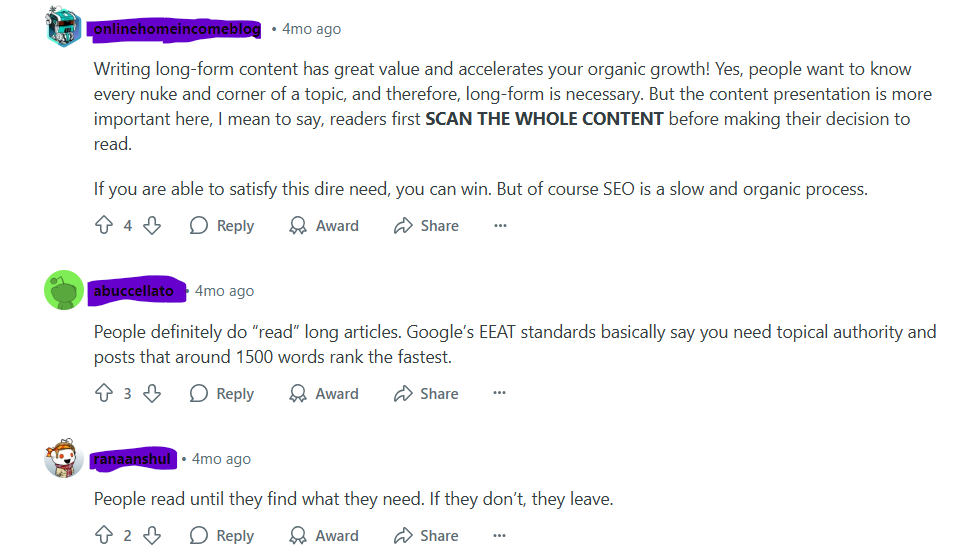
    Avid readers still exist. And if someone is looking for information on a certain topic, they won’t mind taking an extra few minutes out of their day to read an article that will help them. I do it all the time. Ok, so I’m a bit biased as a content writer, but I swear I’m not alone:

    You can always count on Reddit to keep it real. People might skim, but they’ll still read about a topic that they’re interested in.

    With that said, this is why formatting is so important. You’ll want to make sure your blog reads well (AKA is easily skimmable), so that people will want to hang out and read all of your words. If you’re not sure what that looks like, I have a post about it here.

    How to write a long form blog that’s packed with value

    Hopefully by now you understand why long form blogs are beneficial. But as I mentioned above, you don’t want long form content that resembles a fluff-filled high school essay. Here are some tips on organically adding information so your blog becomes *the* blog.

    • Remember that you have the ‘curse of knowledge. Haven’t heard of this phenomenon? It’s defined as “the cognitive bias” where one assumes everyone has the same level of knowledge that they do about a given topic. For example, someone that works in fashion will probably forget that the average person doesn’t know that much about different textiles or styling tricks. It happens to me all the time. Like, what do you mean you don’t know that cashmere comes from the underbelly of a Himalayan Kashmir goat? Or that you don’t know about the sandwich styling trick? Once you remember that a lot of people don’t know what you know, writing about specific topics in depth becomes a lot easier.
    • Go back to the basics and cover all the bases. With that said, your blogs can literally be a crash course in the given topic. So I’ll use the cashmere example again. It’s something that I know a lot about as a fashion copywriter that has worked with cashmere brands, but the average person on the street might not have any clue what it actually is, what animal it’s derived from, what part of the world it comes from, what cultural connotations it has, how to care for it, when to wear it, why it’s considered a luxury fabric, etc etc. Forget the curse of knowledge and remember that all of this information that seems basic to you, is actually new to a lot of people!
    • Try to answer as many questions as possible. Not only is this good for SEO (remember, your goal is to attract the people that are looking for answers to specific questions), it’ll naturally bump up your word count and make your blog extra juicy and valuable. If you’re not sure what questions people are asking, think of related questions you’ve heard IRL or from your customers and questions you’ve seen on discussion-based social media platforms like X, Threads, or Reddit. Another great tool is Answer The Public: simply type your blog topic into the search bar, and it’ll formulate a list of related questions that you can include in your blog. Or, just stay on Google and pay attention to the “People also ask” section.
    • Find ways to provide extra value. Giving answers to often-asked questions is a great start, but you can also go above and beyond by adding in other helpful sections. For example, I recently started working on a series of garment style guides for a client. We start by choosing a specific garment, like a trench coat. The guides cover the definition of the garment, give a historical and cultural overview, provide examples of style icons and celebrities that love the garment, share shopping tips and signs of quality, and give styling tips and outfit ideas based on the wearer’s body type. It combines a lot of elements that are often separated, so you can look at similar types of content to see what they’re missing and use that as a way to improve and bulk up your own articles.

    When to choose a short form blog

    Ok, I’ve given long form blog content a lot of praise so far. But sometimes it’s best to keep things short and sweet.

    Choosing the right content length/word count is really dependent on the topic, so don’t feel bad about opting for a short form piece if that’s what feels right for you. I’ve still seen plenty of blogs under 1000 words rank pretty high on search engines!

    Here’s when to ditch the long form content:

    • You genuinely have no more information to share. Some topics are less complex than others. It’s just the way it is. If your content reads better and feels more engaging in a short form, leave it as is instead of adding in fluff and filler words to hit a certain word count.
    • The keyword/topic doesn’t have a lot of competition. If you’re writing about something very niche, you might be able to get away with short form content because you don’t have a lot of competition. Maybe you’re sharing a time-sensitive announcement that’s specific to your area, like a blog about a pop up event in your city’s main shopping area. If all you have to write is a few hundred words about how the event will work, when it takes place, and the inspiration behind your pop up collection, it’s all good.
    • When you’ve already done the work with other long form blogs. Listen, long form blogs take time! It’s totally fine if you can’t commit to 1500 word blogs every time. You can definitely alternate with shorter blogs, especially if you’ve already released a few foundational long form blogs that are performing well. I’m a big advocate of doing what works best for you.

    So there you have it! The beauty of blog content writing is that while there are best practices, ultimately there are no set rules about what you need to do. Try your best to write comprehensive blogs that really cover the bases of the topics you choose, as they’ll provide more value to readers and look better to search engines. But remember that there’s not a magic word count you have to hit every single time. You may be able to write a wonderfully thorough article in 800 words or 1800 words. It just depends on the topic.


    Blog content for fashion & lifestyle brands

    If the mere thought of writing any piece over 1000 words stresses you out but you still want to reap the benefits of long form blog content, you’re in luck.

    Whether you’re just launching a new blog or you think your existing content can go deeper, I’m happy to offer my fashion & lifestyle blog content & management services.

    If you’re interested in working together, drop me a line to see what I can do for you!

  • What is a high quality blog? The key features to look for

    What is a high quality blog? The key features to look for

    You’ve set up your blog. You have your editorial calendar planned out months in advance. You’re ready to write … but you’re not quite sure if your content is the very best it can be.

    Sound familiar?

    In the content writing world, you’ll often see the term “high quality content.” I won’t lie, it’s a term that can sound incredibly vague to a newbie or industry outsider. That’s why I’m here to break it down, from the words to the formatting and everything in between. Read on to find out what a high quality blog looks like in Google’s all-important virtual eyes!

    High quality blog: a definition

    Ah, quality.

    It’s something we all appreciate and strive towards, but in certain areas it can be hard to determine. Especially when it comes to the digital realm. It’s not like a garment, where you can feel durable fabric and see solid, even stitching.

    I’ll be honest … in some cases, quality is very much subjective. Have you ever watched a movie and thought it was amazing, only to find out it has an embarrassingly low score on Rotten Tomatoes? Blog content — or anything written, for that matter — can feel that way. But there are some key factors that can put a blog in the “high quality” arena, at least from a technical point of view.

    So for the sake of content writing and SEO, a high quality blog is one that:

    • Is informative and provides value to the reader
    • Looks good and is easy to read
    • Is well-written

    This probably still sounds vague, so I’ll break it down even further.

    How to write a high quality blog: provide value & information

    The goal of any blog is to provide information, so that’s pretty straightforward. For example, this blog is providing information by explaining what a high quality blog means in terms of content writing and SEO. As long as you have a clear topic and you cover all* (or at least the most important) the bases, you’ll be golden.

    Now, value is a bit trickier. It’s a word I’m sure you’ve seen a million times in the marketing world.

    Value is subjective, because everyone has a different concept of it. What I find valuable is not necessarily what you might find valuable. I do hope that you’ll find this blog valuable, but your unique concept of value might mean that you don’t. It’s ok, I promise I won’t take it too personally if that’s the case.

    Essentially when it comes to value, the goal is to leave the reader with insights, tips, or action steps that they can start using in their life.

    So with this blog, I’m hoping you’ll be able to walk away feeling more confident in your blog writing and formatting abilities, knowing that you’re on the right track to producing high quality content.

    Let’s say you’re a skincare brand, and your company blog is filled with information, tips, and resources that can help readers overcome common skin issues and product concerns. That’s providing them with value. It’s taking the information within the blog one step further and explaining how they can use their newfound knowledge to make their lives just a little bit better. Again, it’s not guaranteed that every reader will understand or appreciate the value you provide, but all you can do is try.

    How to write a high quality blog: formatting & readability

    So you’ve got all your information and value ready. Now you need to make sure that it’s easy to digest. This is where formatting and readability come into play.

    Humans are visual creatures, and we like things that are easy on the eyes. That very much includes the written word.

    Certain formatting techniques make content (and any form of writing, for that matter) easier to read. This is a bonus in Google’s eyes, because if a page is hard to read, chances are people will close it and find one that isn’t. The good news is that readability and user-friendly formatting are pretty straightforward.

    Think about the types of content you find easy to read, and notice if there are any patterns. I’ll give you a minute.

    In general, humans like variety. We don’t like monotony, which translates to massive blocks of text when it comes to writing. Ever get overwhelmed when your mom sends you a text that looks like an email? Now compare that to when your friend excitedly sends you 10 short messages in a row. The short messages are easier to read, because they’re broken up.

    Pair that with our ever-decreasing attention spans, and you’ll understand why human eyes prefer things in small doses.

    So to write a well-formatted blog in terms of readability, you’ll want to apply those same principles:

    • Avoid big, monotonous blocks of text. Keep your paragraphs short and sweet at just a few sentences per paragraph when possible. I don’t recommend breaking up cohesive ideas just to stick to this rule, but always aim for conciseness.
    • Keep your sentence lengths varied. Readability checkers recommend keeping most of your sentences under 20 words, but if you’ve got to make a point, you’ve got to make a point. In the spirit of variety, it is good to mix up your sentence lengths. Your writing will look and feel off if all of your sentences are the same length — think Bart Simpson’s detention paragraph in the Simpsons intro. Your eyes start to glaze over after the first few sentences.
    • Play around with what I like to call statement sentences. These are one-liners that float between paragraphs. They stand out, much like a statement accessory.
    • Add in headers where appropriate. Headers are amazing at breaking up blocks of text because they’re just so big. They’re also great for SEO — try and use them to strategically insert your targeted keywords. Use a mix of H1, H2, H3, and H4 headers if/when possible. Depending on your website/formatting platform, H1 and H2 headers can look massive. It’s ok to stick to smaller sizes if you think they look better.
    • Use transitional punctuation features like ellipses (…) and em dashes (—) when appropriate. They’re great tools for bringing even more variety to your sentence structures. Plus, they create a little sense of intrigue that keeps readers engaged. When you see one, you start thinking, “What’s going to happen next? Where is this leading to?”
    • Write in an active voice when possible. An active voice is a grammatical structure that places emphasis on a verb and its performer. It’s more clear and direct than a passive voice, which makes it easier to read. For example, “she is wearing a blue sweater” is an active voice. “The sweater is being worn by her” is a passive voice.

    You may have already noticed all of these features in this blog post. Keep an eye out for them in other blog posts — I’m sure you’ll find them.

    If all of that feels like a lot, you can always run your content through a readability checker. Hemingway is free and gives you easy tips on how to edit your content to make it more readable. It also checks spelling and grammar, so the end result will be good to go.

    How to write a high quality blog: good writing

    And last but certainly not least, writing quality. This is perhaps the toughest one because of subjectivity. Just like value, everyone perceives writing quality in their own way.

    The good news is that content writing is not like academic, technical, or even creative writing. It’s a bit more human and casual, so you can have some fun with it. At least I do.

    With that said, you’ll want to make sure your content writing aligns with your company’s brand voice so it feels consistent. I’ll touch on brand voice some other time, but essentially the writing in your blog content should fit in with the rest of the copy in your brand’s marketing and communications (website, social media, email marketing, brochures, or any other form of writing). It should have the same feel and use the same type of language and key phrases.

    You’ll also want writing that’s engaging and interesting — IMO, these are markers of good quality blog writing. If your writing is captivating enough to keep the reader hooked, you’ve done a good job. On top of being informative, valuable, and formatted in a way that’s easy to read, that is. Oh, and having correct spelling and grammar.

    And that’s it, whew! I hope this article has given you a better understanding of what marketers and content writers mean when they talk about high quality blogs.


    There are a lot of things to keep in mind when it comes to writing a high quality blog that ranks. If you’re feeling like none of this is your cup of tea, that’s totally ok, because content writers like me exist!

    Content writing & blog management services

    Whether you’ve already started a blog and are struggling with it or you want to start one but don’t want to do it yourself, I’ve got experience with both content writing and blog management for fashion and lifestyles brands.

    If you’re interested in working together, drop me a line to see what I can do for you!

  • Should you start a blog for your fashion/lifestyle business?

    Should you start a blog for your fashion/lifestyle business?

    Social media, email marketing, and blogging?

    I know, I know — it sounds like a lot. If you’re a fashion or lifestyle business owner, you’ve probably already got a lot on your plate. You may be wondering if starting a blog for your business is worth it, or if you should stick to other forms of marketing.

    Obviously I’m going to be a bit biased as a fashion and lifestyle content writer, but I promise the information that I share below is simply here for you to absorb and consider. Once you’ve pondered it for a little while, you can make a decision based on your needs and wishes.

    If you’ve been debating whether or not to start a blog for your fashion or lifestyle business, this post is for you. I’ll be outlining the key benefits of blogging and sharing some tips to make it work for you if it’s something you want to pursue. So without further ado, let’s get to the juicy stuff!

    The benefits of starting a blog for your fashion/lifestyle business

    I’ll start off by saying that there are definitely upsides to blogging, otherwise it wouldn’t be such a big marketing strategy. It might not be for you, but consider the following benefits …

    Blogging boosts SEO & increases website traffic

    This is probably the number one benefit to blogging. As a business owner, you want more people to be able to find your brand (and website), and blogging is a great way to do so.

    While there are other ways to boost SEO and increase web traffic, blogging is a fairly simple continuous solution.

    Sure, you can optimize all of the pages on your website, but search engines are always on the lookout for fresh content. So you can update your website copy on the regular (which isn’t necessarily a bad idea, but might not be super sustainable), or you can create a steady stream of content with your blog.

    In addition, blogging gives you an infinite amount of opportunities to add relevant keywords to your website. Each post is a new opportunity! There are only so many times you can include keywords on website copy without it sounding unnatural (no one likes keyword stuffing), but blog posts allow you to really elaborate on certain ideas and keywords.

    It also allows people to find you in unexpected ways. Let’s say you’re a cashmere brand that posts an amazing, thorough blog about the material and its origins. Google loves it and it’s on the first page. Now even more people that are curious about cashmere can find your brand, because that blog post might contain keywords that don’t make sense with the rest of your website copy.

    All in all, blogging provides more options, which is never a bad thing when it comes to visibility.

    Blogging builds authority & trust

    You know the old marketing adage — people don’t buy from brands, they buy from people. Especially people they trust.

    Blogging is a great way to show your expertise and provide your audience with value. You can use your blog to share styling advice, care tips, material/textile information, industry trends … you name it! It’s also a great way to show off your own values and interests, which can make your customers feel closer to you.

    Plus, since blogging and long-form content go hand-in-hand, you’ll really have the space to show your knowledge. If you feel restricted by social media or emails, blogging is the perfect platform for letting your wisdom flow.

    Blogging supports social media & email marketing

    Don’t think of blogging as one more thing you have to do — think of it as a complement to your existing marketing efforts.

    You don’t have to reinvent the wheel every time. You’re absolutely allowed to compound and repurpose content between all of your marketing channels.

    What my clients and I like to do is work with monthly themes that we use in blogs, emails, and social media content. It’s nice to start with a blog (which will likely be your beefiest form of content), then condense that information for emails and social media. It really doesn’t have to be a lot of extra work if you don’t want it to be!

    What to keep in mind when starting a fashion/lifestyle blog for your business

    Ok, so now you know that blogging can be a pretty great tool for your business. But it’s important to understand that it isn’t a magical marketing solution.

    Blogging and SEO are very much long-game strategies. Don’t expect overnight results. This is because it can take a while for blogs to rank — anywhere from a few months to a year or more. It’s just the way that search engines work, unfortunately.

    Plus, consistency is key. Search engines like active websites, and that includes an active blog page. You might luck out with one blog post that strikes gold, but your best bet will be to continually post valuable content that can rank.

    You’ll also want to remember that blogging does not equal instant conversion (like any form of marketing, really). These days, people are taking more time than ever to make purchasing decisions. Some people might immediately buy things from a gift guide blog, but others might need some time to build trust and eventually purchase. Still, blogging is a great way to establish that trust and keep your brand top of mind when the customer eventually is ready to make a purchase.

    However, the silver lining is that your patience can pay off big time. Some businesses get the majority of their web traffic from SEO blogs!

    How to make blogging work for your fashion or lifestyle brand

    Think you’re ready to blog? It’s always smart to have a plan that works for your business. Before you get started on your editorial calendar, here are some tips for instilling sustainable blogging practices:

    • Set a realistic posting schedule. As I mentioned above, consistency is key. Don’t get overly ambitious with 8 blogs a month if you don’t think you can actually handle posting that much. Take a look at your schedule and try to gauge how much time you have for maintaining a blog. If one is all you can handle for now, so be it. It’s always good to keep yourself accountable by creating a set schedule (ie. the 1st and 15th of every month).
    • Choose quality over quantity. With that in mind, opt for quality over quantity — something that makes sense for so many aspects of life, don’t you think? Consistency is important, but it’s better to publish a few high quality blogs than a bunch of mediocre ones. Now, what exactly does quality mean when it comes to a blog? You’ll want content that’s engaging, informative, and easy to read. Make sure it covers all the bases of your topic, provides value, is written well, and is formatted in a way that makes it aesthetically pleasing and easy to digest.
    • Target your ideal customer. Make sure you’re choosing topics that your customers are interested in, and think about any problems you can solve for them. If you’re struggling to figure out topics, you can research what competitors are writing about, or go directly to the source. If you have a physical storefront, pay attention to the questions and concerns your customers have. If not, you can pull topics from your FAQ, poll your followers on social media, or use discussion-based platforms like Reddit or Threads to find out what your customers’ most burning questions are.

    When a blog might not be the right fit

    Despite all of the benefits that blogging can provide a fashion or lifestyle business, it might not be for you. And that’s okay. I’m just here to provide insight.

    Shelf it for now if you feel that you don’t have the time or resources for it. If I haven’t hammered in the importance of consistency and quality by now, I’ll mention it again. It’s better to wait until you can really give blogging your all.

    Also, you know your customers better than anyone. Maybe they’re very into visuals and short-form content, so social media is your bread and butter. If your existing marketing efforts are doing everything they need to do, then you’ll probably be good without a blog. If it ain’t broke, don’t fix it.


    Content writing & blog management services

    If you are interested in starting a blog for your fashion or lifestyle business, you know I’ve got your back. Whether you have the infrastructure in place and just need help with the content or you’re looking for someone to fully take the reins, I’ve got experience with both content writing and blog management.

    Drop me a line to talk about what I can do for you!