

If you’ve been thinking about starting a blog for your fashion or lifestyle brand, you’ve probably been wondering what the blog articles should look like. Or, more specifically, how long they should be.
Maybe you’ve been chatting with a content writer and have felt lost when they brought up word count. Or maybe you’ve written a few posts already, but you’re not sure if you’re in the right ball park in terms of blog length — especially if you have SEO goals you want to hit.
Worry not, because you’re in the right place. Below I’ll be discussing all things blog length, and whether short or long form blogs are better for SEO. You’ll soon have all the clarity you need to tackle your content calendar.
How long should your blogs be?
Sorry to be that person, but there’s no single correct answer to this question. It really depends on the individual blog and its topic. However, long form blogs generally tend to perform better (AKA rank higher) when it comes to SEO.
Why, you may be wondering?
Essentially, long form blogs tend to be perceived as more valuable. This is because they naturally contain more information than short form blogs. Let’s look at travel guide blogs as an example.
Say you’re planning a trip to New York, and you want some help planning your itinerary. Which guide would you find more helpful: a short one that only recommends one coffee shop, one restaurant, and one park? Or a longer, more detailed one that gives several options for each category, as well as recommending scenic walking routes, shopping destinations, museums, and miscellaneous hidden gems?
I’m guessing you’d choose the second one. The same principle applies to any kind of content — the more helpful information you can provide, the more valuable your blog will appear to a search engine, and the higher it should theoretically rank.
Search engines prioritize content that really answers questions people are looking for, and most of the time* they tend to be long form blogs.
*With that said, I’ll reiterate my motto of quality over quantity. Don’t force a long form blog — you don’t want to sound like a desperate high school student trying to make their essay sound better with fluffy filler words. If you can share everything you need to share in 700 words, so be it.

What is a long form blog?
Before I go on, you may be wondering exactly what I mean when I say “long form blog”. If it’s been a while since you’ve dealt with word counts, here’s a quick overview of what is considered short, medium, and long in the world of content writing.
- A short form blog tends to be around the 500 or 600 word count, or possibly a bit less. Think of it as a short essay or article you’d read in a newspaper or magazine. It’s usually a good length for a quick overview of a topic.
- A medium form blog ranges from 700 – 1200 words. It’s obviously meatier than a short form blog, and I find it’s a good length to provide comprehensive value for many topics in the fashion and lifestyle industries.
- A long form blog is anything above 1200 words, but generally reaches a cap around the 2000 or 2500 word mark. IMO, anything longer is delving into e-book territory. Of course, you can pack a lot of information into these kinds of blogs, but only choose this length if you’re sure it’s a topic that can be written about in such an extensive manner.
Note: These definitions are not rigid. Many marketers and writers have their own ideas of what short, medium, and long form content look like. I chose these numbers based on averages that I’ve witnessed and the blogs I write for my clients. Still, you should now have an idea of what content writers mean when they talk about word counts and blog lengths.
The benefits of long form blogs
To recap, here’s why you may want to opt for a medium or long form blog over a short form one:
- They tend to rank higher in search engines
- You can provide readers with more value by adding in helpful information & answering their most pressing questions
- You can show off your expertise, therefore building greater credibility & authority in your industry (bonus points if your blog gets shared and linked because it’s just that valuable)
- If the reader is truly engaged, they’ll end up spending more time on your website (reducing that dreaded bounce rate)
- You can use it as a foundation for other content — you can make social media posts and emails based off sections of the blog, streamlining your content creation process as a whole
So even though a long form blog might seem intimidating, the pay off can be well worth it!

Do people still read long form blogs?
Now, I know what you might be thinking at this point.
“But Maria, it’s 2025 and the human attention span is shorter than a goldfish’s. Is anyone even going to read my long form blog?”
It’s a fair point. A lot of people may prefer getting their information from punchy 15 second reels. But there’s still an audience for long form content — data from blogging platform Medium showed that their best performing articles tended to be around 1600 words long.
Avid readers still exist. And if someone is looking for information on a certain topic, they won’t mind taking an extra few minutes out of their day to read an article that will help them. I do it all the time. Ok, so I’m a bit biased as a content writer, but I swear I’m not alone:
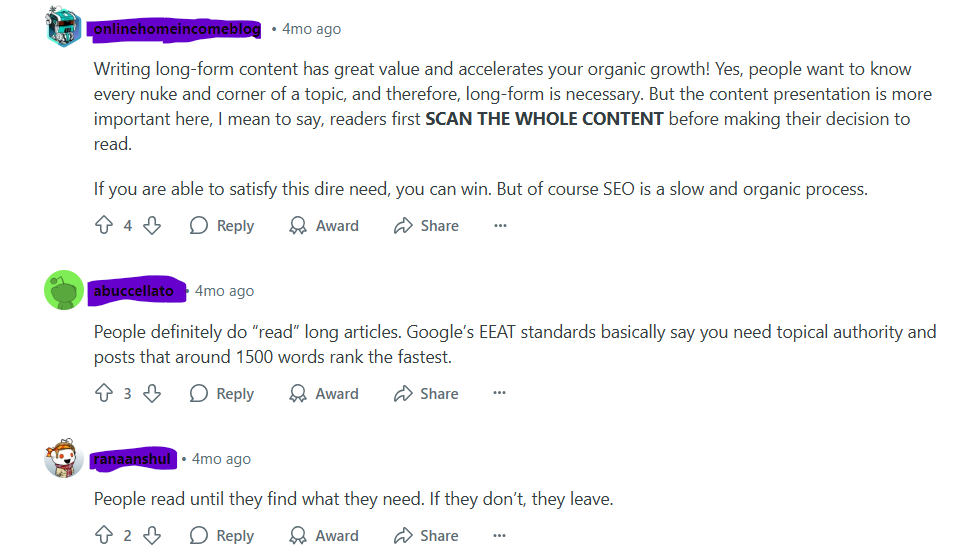
You can always count on Reddit to keep it real. People might skim, but they’ll still read about a topic that they’re interested in.
With that said, this is why formatting is so important. You’ll want to make sure your blog reads well (AKA is easily skimmable), so that people will want to hang out and read all of your words. If you’re not sure what that looks like, I have a post about it here.
How to write a long form blog that’s packed with value
Hopefully by now you understand why long form blogs are beneficial. But as I mentioned above, you don’t want long form content that resembles a fluff-filled high school essay. Here are some tips on organically adding information so your blog becomes *the* blog.
- Remember that you have the ‘curse of knowledge‘. Haven’t heard of this phenomenon? It’s defined as “the cognitive bias” where one assumes everyone has the same level of knowledge that they do about a given topic. For example, someone that works in fashion will probably forget that the average person doesn’t know that much about different textiles or styling tricks. It happens to me all the time. Like, what do you mean you don’t know that cashmere comes from the underbelly of a Himalayan Kashmir goat? Or that you don’t know about the sandwich styling trick? Once you remember that a lot of people don’t know what you know, writing about specific topics in depth becomes a lot easier.
- Go back to the basics and cover all the bases. With that said, your blogs can literally be a crash course in the given topic. So I’ll use the cashmere example again. It’s something that I know a lot about as a fashion copywriter that has worked with cashmere brands, but the average person on the street might not have any clue what it actually is, what animal it’s derived from, what part of the world it comes from, what cultural connotations it has, how to care for it, when to wear it, why it’s considered a luxury fabric, etc etc. Forget the curse of knowledge and remember that all of this information that seems basic to you, is actually new to a lot of people!
- Try to answer as many questions as possible. Not only is this good for SEO (remember, your goal is to attract the people that are looking for answers to specific questions), it’ll naturally bump up your word count and make your blog extra juicy and valuable. If you’re not sure what questions people are asking, think of related questions you’ve heard IRL or from your customers and questions you’ve seen on discussion-based social media platforms like X, Threads, or Reddit. Another great tool is Answer The Public: simply type your blog topic into the search bar, and it’ll formulate a list of related questions that you can include in your blog. Or, just stay on Google and pay attention to the “People also ask” section.
- Find ways to provide extra value. Giving answers to often-asked questions is a great start, but you can also go above and beyond by adding in other helpful sections. For example, I recently started working on a series of garment style guides for a client. We start by choosing a specific garment, like a trench coat. The guides cover the definition of the garment, give a historical and cultural overview, provide examples of style icons and celebrities that love the garment, share shopping tips and signs of quality, and give styling tips and outfit ideas based on the wearer’s body type. It combines a lot of elements that are often separated, so you can look at similar types of content to see what they’re missing and use that as a way to improve and bulk up your own articles.

When to choose a short form blog
Ok, I’ve given long form blog content a lot of praise so far. But sometimes it’s best to keep things short and sweet.
Choosing the right content length/word count is really dependent on the topic, so don’t feel bad about opting for a short form piece if that’s what feels right for you. I’ve still seen plenty of blogs under 1000 words rank pretty high on search engines!
Here’s when to ditch the long form content:
- You genuinely have no more information to share. Some topics are less complex than others. It’s just the way it is. If your content reads better and feels more engaging in a short form, leave it as is instead of adding in fluff and filler words to hit a certain word count.
- The keyword/topic doesn’t have a lot of competition. If you’re writing about something very niche, you might be able to get away with short form content because you don’t have a lot of competition. Maybe you’re sharing a time-sensitive announcement that’s specific to your area, like a blog about a pop up event in your city’s main shopping area. If all you have to write is a few hundred words about how the event will work, when it takes place, and the inspiration behind your pop up collection, it’s all good.
- When you’ve already done the work with other long form blogs. Listen, long form blogs take time! It’s totally fine if you can’t commit to 1500 word blogs every time. You can definitely alternate with shorter blogs, especially if you’ve already released a few foundational long form blogs that are performing well. I’m a big advocate of doing what works best for you.
So there you have it! The beauty of blog content writing is that while there are best practices, ultimately there are no set rules about what you need to do. Try your best to write comprehensive blogs that really cover the bases of the topics you choose, as they’ll provide more value to readers and look better to search engines. But remember that there’s not a magic word count you have to hit every single time. You may be able to write a wonderfully thorough article in 800 words or 1800 words. It just depends on the topic.

Blog content for fashion & lifestyle brands
If the mere thought of writing any piece over 1000 words stresses you out but you still want to reap the benefits of long form blog content, you’re in luck.
Whether you’re just launching a new blog or you think your existing content can go deeper, I’m happy to offer my fashion & lifestyle blog content & management services.
If you’re interested in working together, drop me a line to see what I can do for you!