

Deprecated: version_compare(): Passing null to parameter #1 ($version1) of type string is deprecated in /dom146695/wp-content/plugins/gravityforms/includes/addon/class-gf-addon.php on line 5706

Deprecated: Return type of GF_Field::offsetExists($offset) should either be compatible with ArrayAccess::offsetExists(mixed $offset): bool, or the #[\ReturnTypeWillChange] attribute should be used to temporarily suppress the notice in /dom146695/wp-content/plugins/gravityforms/includes/fields/class-gf-field.php on line 84

Deprecated: Return type of GF_Field::offsetGet($offset) should either be compatible with ArrayAccess::offsetGet(mixed $offset): mixed, or the #[\ReturnTypeWillChange] attribute should be used to temporarily suppress the notice in /dom146695/wp-content/plugins/gravityforms/includes/fields/class-gf-field.php on line 90

Deprecated: Return type of GF_Field::offsetSet($offset, $data) should either be compatible with ArrayAccess::offsetSet(mixed $offset, mixed $value): void, or the #[\ReturnTypeWillChange] attribute should be used to temporarily suppress the notice in /dom146695/wp-content/plugins/gravityforms/includes/fields/class-gf-field.php on line 99

Deprecated: Return type of GF_Field::offsetUnset($offset) should either be compatible with ArrayAccess::offsetUnset(mixed $offset): void, or the #[\ReturnTypeWillChange] attribute should be used to temporarily suppress the notice in /dom146695/wp-content/plugins/gravityforms/includes/fields/class-gf-field.php on line 108
seo – Maria Polansky

Tag: seo

  • Is blogging still worth it for fashion & lifestyle brands?

    Is blogging still worth it for fashion & lifestyle brands?

    With AI overviews changing the search engine landscape, you’re probably wondering if blogging is even worth it anymore.

    They’re the first thing you see when you open up Google, and I can’t lie … they usually give pretty decent summaries about the question or topic given.

    But that doesn’t mean that blogging is dead. It just means that it’s changing. Read on to find out exactly what I mean and learn the answer to the million dollar question — if blogging is still worth it for fashion and lifestyle brands.

    Do you need a blog for your fashion or lifestyle brand’s website?

    No. It’s not as much of a need as say, a home page or product pages. There are plenty of fashion and lifestyle brands that are doing great without having a blog on their website.

    However, having a blog can still be very beneficial for fashion and lifestyle brands, even in this day and age. Here are a few reasons why:

    Enhances SEO + organic traffic

    Yes, even with the rise and prevalence of AI overviews, blogging is still a great way to boost your website’s SEO and bring in more organic traffic that hopefully includes new ride-or-die fans of your brand. What a lot of people don’t realize is that AI isn’t making up overviews from scratch — it’s pulling information from well-ranking articles and websites.
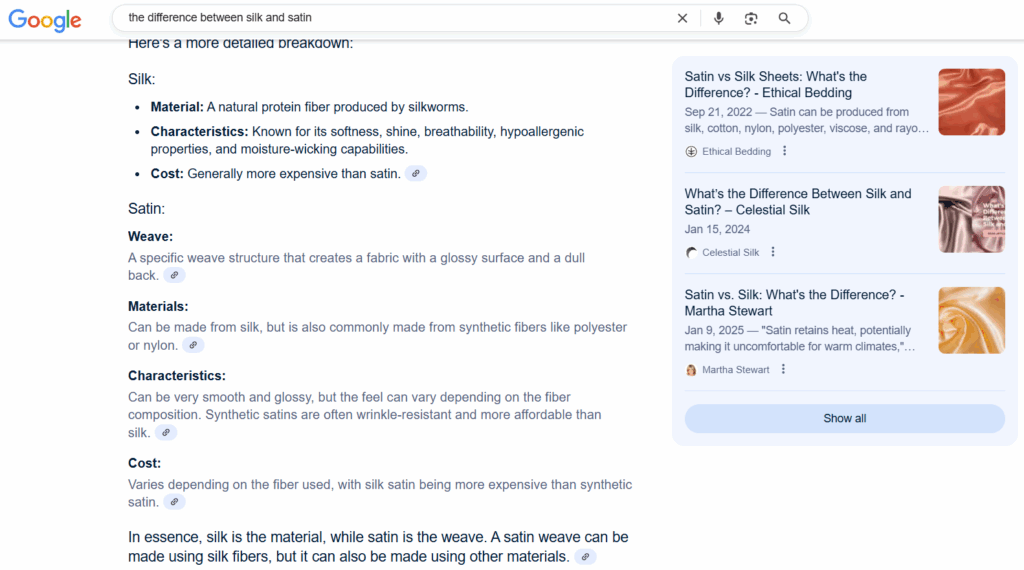
    Take a good, long look at this screenshot I took from my quick search about the difference between silk and satin.

    Sure, the first thing that came up was an AI overview. But observe the little symbols that appear next to every point. They’re links to the blog articles and web pages that the AI got its information from. And on the far right side of the screen? You can see three articles that were used to create the overview, and all of them come from the blogs and websites of lifestyle brands.

    So it’s not that AI overviews are making blogging redundant. AI overviews rely on blog articles to create these overviews. If your article ranks well, it’ll be right up there in the overview. Plus, some of the old principles of SEO still apply. If you scroll past the AI overview, you’ll still see the first page of the search engine and the highest ranking articles.
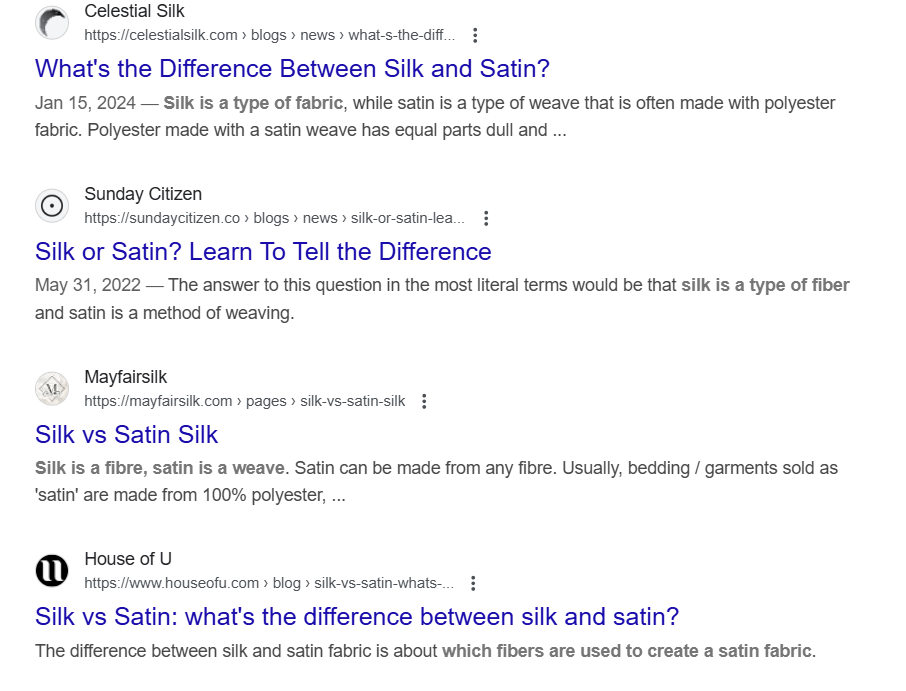
    With the exception of one, all of these top-ranking articles come from company blogs! Very telling stuff, isn’t it?

    Improves visibility

    Ever heard the saying “don’t put all your eggs in one basket”? Of course you have. Blogging is just another way to increase visibility and build brand awareness.

    The issue with social media is that your profile is never truly yours. Yes, you created all that content — but it technically belongs to the platform. If Instagram goes down or bans your page for some reason, then poof. All your hard work is gone. Emails are also great, but they can be deleted at any time.

    Having a solid website is so important, and blogging is just another way to make it richer and deeper.

    Creates a greater connection with your customers

    Social media and email marketing are great and have their own unique set of benefits, but they can be limiting in terms of space. Even the longest-form captions and emails don’t let you dive quite as deep into a topic as a blog post does.

    There’s also the headspace aspect. When people are on social media or checking their emails, they’re often in fast consumption mode. They probably want to quickly read and scroll onto the next thing, which is why short-form content reigns supreme on these platforms.

    But when you open a blog post? You’re more committed to reading, learning, and engaging. You’ve got yourself settled on the couch with a nice hot beverage at your side, and you’re ready to dive in. Ok, maybe that’s not always the case, but you’ve got to admit your headspace is different when you’re truly in reading mode.

    Blogs give you all the space you need to fully share your knowledge and educate your reader on the topic, therefore creating a deeper level of connection. Who knows, you just might end up writing the blog article that changes their perspective on an important topic — like learning the difference between silk and satin once and for all.

    Positions you as an expert in your industry

    A blog page filled with amazing resources for your audience is going to make you look good. I mean, why wouldn’t it?

    Let’s say you have a solid skincare brand, and a blog filled with articles and resources about sustainability, zero-waste living, and skincare tips. Your brand is going to look more legit than the competitor brand that doesn’t have any of that.

    Having a blog provides a lot of value to your audience, and it proves that you know your stuff. It’s like having a meal at a five star restaurant, where the server takes the time to explain the dish and the ingredients. You could have a delicious meal by itself, but the extra knowledge really proves the chef’s expertise.

    Streamlines content creation as a whole

    This might sound counterintuitive. After all, blogging is yet another form of marketing you’re adding to your already-full plate.

    But what if I told you blogging makes one of the best foundations for a general content strategy?

    Since blogs cover so many different aspects of a topic, you can use a single blog to create multiple emails and social media posts. It actually makes content creation easier, because you’re not reinventing the wheel every single time. Trust me, it really works. It’s a strategy I love using with my retainer clients.

    How to adapt your blogging strategy in the AI overview age

    Ok, so we know that while the internet has changed, some things remain the same. Blogging is still a great way to boost SEO and organic traffic, improve your brand’s overall visibility, build deeper connections with your audience, and position your brand as an authority/expert in your industry.

    But it’s a fact that AI overviews have changed the game. You can still get your blogs to rank, you just need to adapt them so they’re more appealing to the bots.

    While having high quality content is important, you might need to change the structure of your posts. Here are a few tweaks you can apply to your blog posts to make them more AI overview-friendly:

    Use your titles and headers strategically

    This has always been important, but now it’s extra important. You’ll want your titles and headers to really align with keywords and search terms, so save the prettier language for other forms of marketing and keep it very, very simple.

    Think about the words and phrases that your ideal customer would use. And if you’re not sure what that might look like, think about the words and phrases that you might use when you’re looking for something specific.

    For example: is it safe to wear gold jewelry in the pool?

    It doesn’t sound as nice as a title like “poolside jewels: gold pieces for your hot girl summer”, but it’s what people are actually searching for. You can use the fun titles for your email marketing and social media campaigns. Blogging these days is really about strategy.

    Make sure your content is clear, concise & conversational

    AI overviews are clear, concise, and (for the most part) conversational, which means your blog content should also be clear, concise, and conversational.

    It pulls phrases directly from blog posts, so you’ll want to write your sentences in a way that makes sense for an overview.

    And that’s where the conversational aspect comes in. You can and should stick to your brand voice, which might lean more elegant or playful, but try to write sentences that a person would actually say (or search) in real life.

    It’s not too dissimilar to older SEO blogging practices, but to familiarize yourself with this type of content you can spend some time looking at AI overviews and the kind of language they use, as well as the websites and blogs they tend to pull information from.

    So there you have it! Despite the changing technological landscape, most would agree that blogging is still very much worth it for fashion and lifestyle brands. If you’re still on the fence, you can learn a little bit more about the benefits of blogging here. And if you’re ready to start blogging? Stay focused and stay committed. I’m sure you’ll be pleasantly surprised at the outcome.


    Content writing & blog management services

    Want to give blogging a go, but not sure you’ve personally got the bandwidth? I just might be your girl.

    You can learn more about my content writing and blog management services for fashion and lifestyle brands here, or drop me a line if you’d like to personally chat about what I can do for you.


  • SEO opportunities you might be missing on your fashion or lifestyle brand’s website

    SEO opportunities you might be missing on your fashion or lifestyle brand’s website

    Does SEO feel more like a four letter word to you than a three letter abbreviation?

    Look, I get it. It can seem intimidating at first, especially if you’re more of a creative at heart. It’s probably why you work in fashion, beauty, interior design, or another lifestyle-oriented field. You want your brand’s website to look good and you want the copy to tell a story. The analytical side just isn’t as fun, and that may be why your website has some missed opportunities when it comes to SEO.

    The good news? It’s not as scary or hard as you think it might be, and I’m here to explain exactly why. Let’s go!

    Glossary: SEO copywriting terms to know

    Before I share the juicy details, let’s go over some terms that’ll make the rest of this blog easier to digest.

    • Keyword. This one is pretty straightforward. We know that a keyword is another way to describe a search term, especially one that you want your brand or product to be known for, like “waterproof gold vermeil jewelry” or “men’s black corduroy baseball cap”. But I think sometimes we overlook the full context of the keyword. To understand how to best apply keywords and how to adapt them to the copy style, you’ll need to consider the customer’s journey or intent.

      Those super straightforward, descriptive keywords I just used? They work perfectly for product pages and descriptions, because they’re the kind of terms someone would input into a search engine when they’re in shopping mode. But if someone is in research mode? That’s when you adapt. Take the root keyword and change it to a related phrase or sentence that someone would likely be searching for, like “can you wear waterproof gold vermeil jewelry in the ocean”, and use that in a FAQ or possibly an ‘about’ page, or turn it into a blog. Maybe I’m oversimplifying it, but that’s really what SEO comes down to: making sure you’re integrating words and phrases that real people would actually search.
    • Keyword stuffing. Ok, so you’ve got your keywords. Now you have to make sure you’re using them in a way that makes sense and feels organic. Keyword stuffing is the opposite of that. It’s using the keywords too much — for example, “this men’s black corduroy baseball cap is the perfect casual baseball cap to complement your everyday wardrobe. With its rich texture and timeless colour, this men’s black corduroy baseball cap easily matches any outfit. If you’re looking for your next favourite accessory, look no further than this men’s black corduroy baseball cap.” It just sounds spammy and bad.

      Of course, you’ll want your copy or blog content to feature your desired keyword(s) a few times so that search engines can easily find your website. But try to do it in a natural way without unnecessary repetitions.

    There are even more technical terms you could research, but for the purpose of this blog we’ll move on. With this information about keywords in mind, consider all the pages and places you can improve your website’s SEO.

    Home page

    If your home page is mostly visuals, you may want to add a bit of extra copy to subtly squeeze some keywords in.

    They don’t have to be super long — it’s understandable if you want your home page to be bold, punchy, and to the point. Consider adding in brief descriptions of every section to bulk up your keyword count and improve user experience. Of course it’s fine and helpful to have separate pages to go over sections more thoroughly, but you can’t assume that every visitor will click through to them.

    Having short paragraphs that explain each section of your home page is a win-win: you’ll be able to use the copy as both an SEO opportunity and a way to explain what your brand is all about on just one page. And if you’d rather lead with visuals? All good. You can keep the bolder graphics at the top of the page, and add in copy towards the bottom.

    About page

    Your ‘about’ page is allowed to be more text-heavy than others. After all, it’s likely where you’re doing the most explaining — sharing your story, vision, mission, materials, etc. Use it as an opportunity to slide in helpful keywords as necessary.

    Of course, there will be the general overview of your brand, like “[Brand name] is a zero-waste women’s swimwear brand.” But you can also use subsections and subheadings (as well as body copy) to insert a few extra keywords, like “swimwear made from recycled materials”, “size-inclusive swimwear”, or “full coverage women’s swimwear.”

    Again, the copy doesn’t have to be super lengthy, but you really have an opportunity to make it count on an ‘about’ page.

    Product pages

    You might want to let the visuals do the talking, but taking the extra time to add in a product description is worth it. Online shoppers are looking for products just like yours every single day (more like every single second), so beefing up your product pages with accurate descriptions is important.

    Product descriptions can be tricky because they’re so short, making keyword stuffing more obvious. You might only be able to get away with placing the right keyword in the description itself once (repeating ‘pear shaped sapphire ring’ more than once in just a few sentences probably won’t read very well), but you’ll have other opportunities within the product page.

    There’s the product title, of course. Then you can add in subsections like “details”, “styling tips”, “designer notes”, and “care tips”, depending on the nature of the product. This creates a more organic way to add in extra keywords while providing value to the customer.

    Collection/category descriptions

    Ok, so you’ve got your individual product descriptions. But what about descriptions of the collections and/or categories they’re a part of? Whether it’s a collection that’s unique to your brand (for example, the ‘Sicilian Summer’ collection) or general product categories like tops, dresses, jackets, and pants, these blurbs are another great way to sneak in more keywords.

    These descriptions are typically longer than an individual product description, but still concise. Those extra few sentences give you ample opportunity to add in products your brand is particularly well-known for (ex. ‘cashmere sweaters’ and ‘merino wool cardigans’ for a knitwear category description), as well as occasions you’d use them for (ex. everyday tote bags for work, spacious backpacks for travel).

    And if you don’t want these descriptions to be super obvious? Place them at the bottom of the category page (you can even add in a drop-down function to hide more of the text), where they’ll do the work while being mostly out of sight.

    FAQ

    Your FAQ doesn’t just have to answer shipping and delivery questions. Use it to answer product-related questions that allow you to organically add in keywords. Things like product care tips, fit questions, and even sustainability/manufacturing questions are all great ways to beef up your FAQ.

    Images

    Take a look at your media library. What do your image file names look like? A random mix of letters and numbers, or real sentences that integrate keywords?

    Images are an often overlooked but super easy way to add in keywords. Simply ensure your file names are strategically named with keywords. You can still use design names, just be sure to follow them up with an SEO-friendly description of what the product is. For example, “Riley halter neck floral midi dress.”

    Company blog

    And last but certainly not least, a company blog. Blogs are an excellent way to boost your SEO rankings, because they provide a constant stream of fresh content. Plus, you can really focus on a particular topic, allowing you to organically include the keyword several times over.

    There are only so many times you can refresh your website copy — and there’s only so much SEO website copy you can write without it feeling fluffy. A blog, on the other hand? You can add a new post every day if you want to!

    I’ve done deeper dives on the SEO benefits of blogging for fashion and lifestyle brands here and here, so I’ll let you explore those blogs if you want to learn more.

    Essentially, every page and section on your website is a little SEO opportunity. And the more places you can sprinkle in keywords, the better your chances of ranking will be. You don’t need to go over the top — in fact, you shouldn’t. But make sure your bases are covered, and enjoy the benefits of greater visibility.


    SEO copywriting for fashion & lifestyle brands

    Think your website could use a SEO boost?

    Whether you’re building your website from scratch or it needs a mid-season glow up, I can help. From full web pages to product descriptions and collection overviews, I can blend SEO strategies with an on-brand tone of voice so you get the best of both worlds.

    Learn more about my fashion & lifestyle copywriting services here, or drop me a line if you’d like to chat directly!